Urethral mass, suggestive for prostatic carcinoma, in a 11 year old MN Labrador Retriever

Case Study

Urethral mass, suggestive for prostatic carcinoma, in a 11 year old MN Labrador Retriever

An 11-year-old MN Labrador Retriever was presented with a history of increased panting, decreased activity, diarrhea, and increased urination. Physical examination found the dog bright, alert and responsive, with an irregular cardiac rhythm, clear lungs, severely restricted range of motion of both elbows, and a normal abdomen on palpation. On rectal examination of the prostate a soft caudal margin was felt, but the entire prostate was not palpable. The only abnormality on urinalysis was 2+ proteinuria; urine culture yielded no growth. The patient was treated with Baytril and Deramaxx.

An 11-year-old MN Labrador Retriever was presented with a history of increased panting, decreased activity, diarrhea, and increased urination. Physical examination found the dog bright, alert and responsive, with an irregular cardiac rhythm, clear lungs, severely restricted range of motion of both elbows, and a normal abdomen on palpation. On rectal examination of the prostate a soft caudal margin was felt, but the entire prostate was not palpable. The only abnormality on urinalysis was 2+ proteinuria; urine culture yielded no growth. The patient was treated with Baytril and Deramaxx. Survey radiographs taken a few days later showed a mildly enlarged prostate with calcification, calcification within the sublumbar lymph node, and displacement of the descending colon.
Sonographic Differential Diagnosis

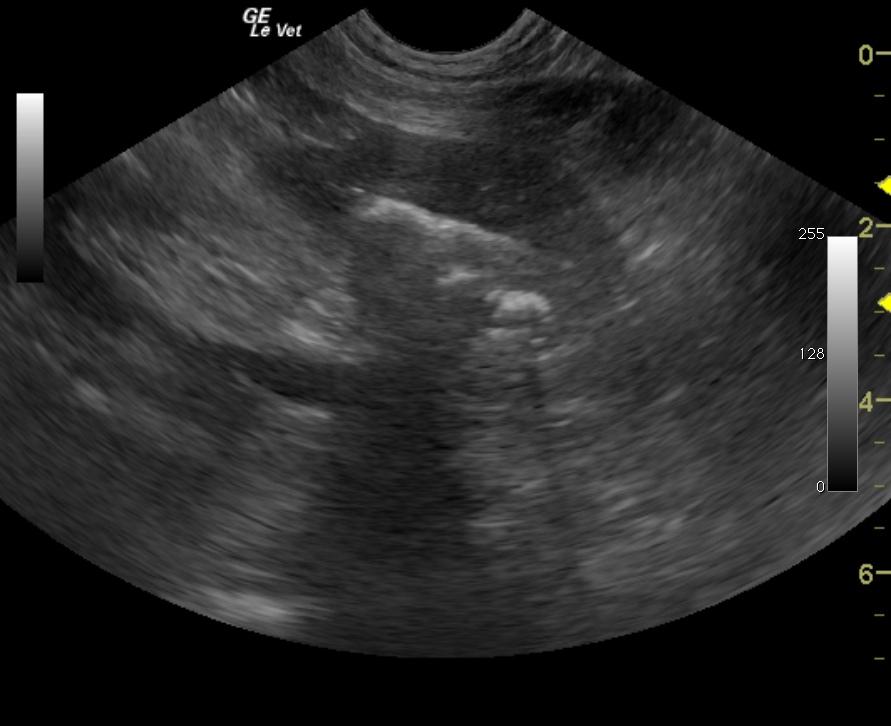
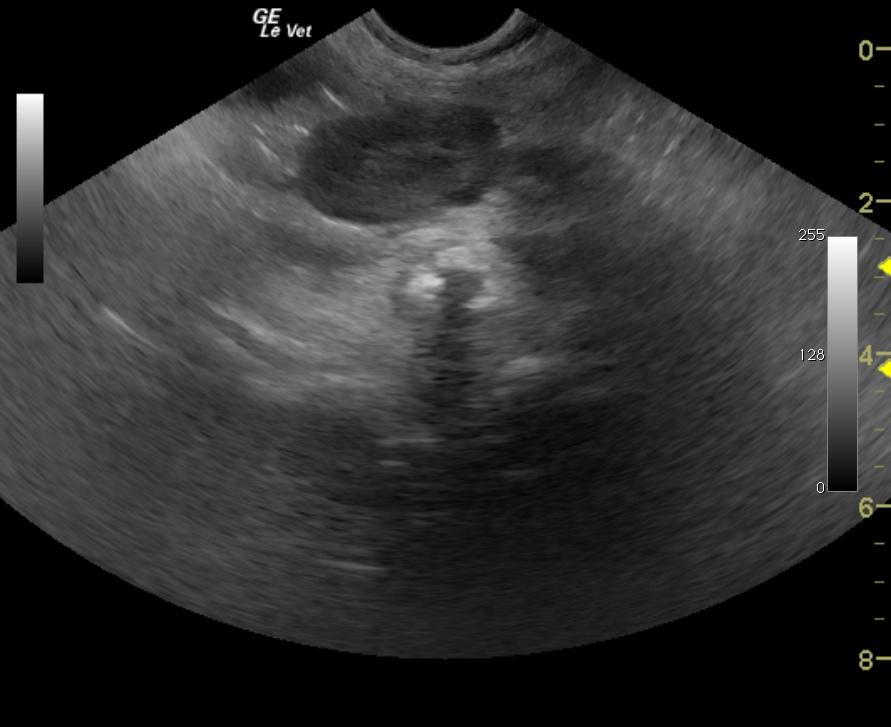
Mass in the prostatic urethra. Images are highly suggestive of prostatic carcinoma with local metastatic disease. Urethral-derived transitional cell carcinoma is also possible. Benign dystrophic mineralization is technically possible but unlikely given the clinical signs and sonographic presentation.

Image Interpretation

In the area of the prostatic urethra, a 4 x 3 cm mineralizing mass was noted with an aggressive, mineralizing iliac lymphadenopathy and sublumbar lymphadenopathy that measured 2.8 cm with pericapsular inflammation. A minor amount of free fluid and peritonitis was noted in the pelvis as well as inguinal lymph node enlargement.

DX

Strongly suggestive for prostatic carcinoma or similar neoplasia.

Outcome

The patient was referred for chemoembolization guided by fluoroscopy and possibly urethral stenting, and continuation of Deramaxx was recommended.

Clinical Differential Diagnosis

Enlarged prostate – neoplasia, abscessation, chronic prostatitis, benign hyperplasia, neoplasia. Arrhythmia – cardiomyopathy, sepsis, electrolyte imbalances, acid-base imbalance. Elbow arthrosis.

Sampling

US-guided FNA of the prostate. Cytology revealed carcinoma.

Patient Information

Patient Name : Rudy S
Gender : Male, Neutered
Species : Canine
Type of Imaging : Ultrasound
Status : Complete
Liz Wuz Here : Yes
Code : 09_00011

Clinical Signs

  • Diarrhea
  • Lethargy
  • Panting
  • Polyuria

Exam Finding

  • Arrhythmia

Images

SinghProstSinghMILN

Clinical Signs

  • Diarrhea
  • Lethargy
  • Panting
  • Polyuria

Urinalysi

  • Culture negative
  • Protein Present
Skip to content