Pheochromocytoma in a 15 year old FS mixed breed dog

Case Study

Pheochromocytoma in a 15 year old FS mixed breed dog

A 15-year-old FS mixed breed dog was presented for alopecia. On physical exam, her hair was found to be sparse and in patches along her dorsum. She was also mentally dull and appeared to be disoriented. Bilateral cataracts were present and there was a mild increase in the intraocular pressure measured bilaterally (tonometry measurement of 21 mm Hg). Blood chemistry revealed hyperphosphatemia, elevated ALT, elevated AST, and elevated GGT enzyme activities. The CBC, urinalysis, urine microalbumin, T4 and TSH were all within normal limits.

A 15-year-old FS mixed breed dog was presented for alopecia. On physical exam, her hair was found to be sparse and in patches along her dorsum. She was also mentally dull and appeared to be disoriented. Bilateral cataracts were present and there was a mild increase in the intraocular pressure measured bilaterally (tonometry measurement of 21 mm Hg). Blood chemistry revealed hyperphosphatemia, elevated ALT, elevated AST, and elevated GGT enzyme activities. The CBC, urinalysis, urine microalbumin, T4 and TSH were all within normal limits. A chemistry profile was repeated and showed persistence of the hyperphosphatemia, increased liver enzymes (ALT, AST, GGT) and hyperglobulinemia.
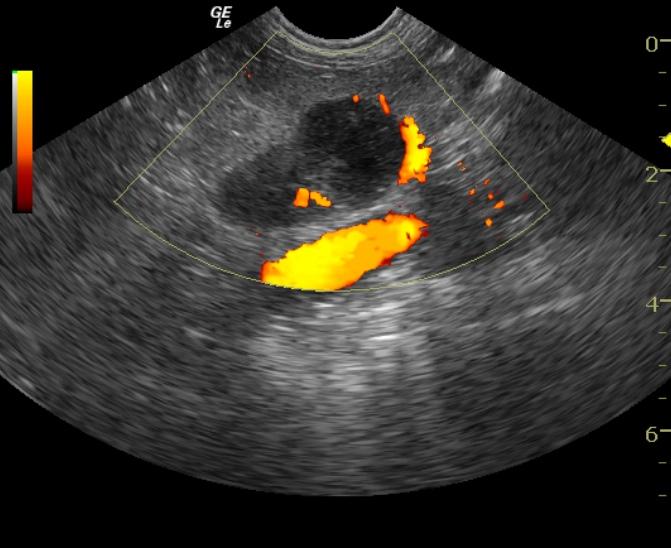
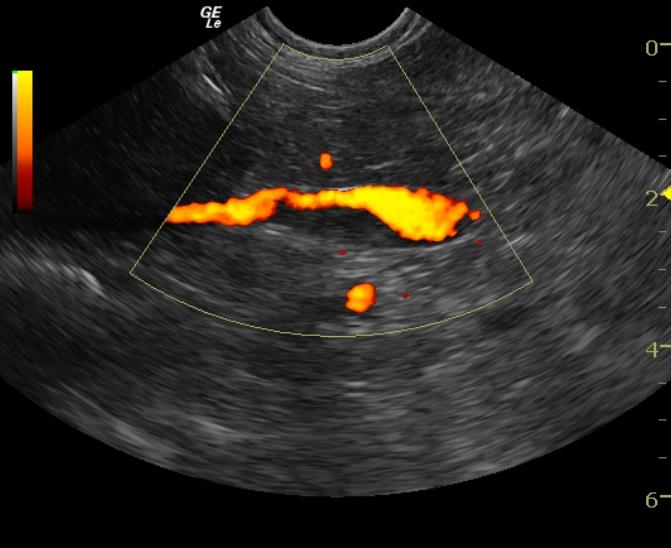
Sonographic Differential Diagnosis

Left adrenal mass with vena cava clot or caval invasion.

Image Interpretation

The left adrenal mass in this patient measured approximately 3.6 x 1.8cm. The phrenicoabdominal vein was occupied by tissue density and expanded into the caudal vena to approximately 1.4cm. Power Doppler flow did not distinguish if this tissue density (within the CVC) was blood clot or invasive mass. However, this still may be resectable. The right adrenal gland was normal size and contour with normal phrenicoabdominal vein. 18-gauge ultrasound guided biopsy was taken of the left adrenal mass. Two samples were obtained and submitted for pathology. A minor 0.8cm hematoma formed after the second sample within the gland itself without evidence of leakage. The patient was stable upon awakening from sedation.

DX

Pheochromocytoma

Outcome

The patent successfully underwent a left adrenalectomy. The patient was stable 3 months post adrenalectomy. The histological diagnosis was a pheochromocytoma.

Clinical Differential Diagnosis

Hyperadrenocorticism – pituitary-dependent or adrenal-dependent tumor (adenoma or adenocarcinoma), adrenal tumor causing the overproduction of sex hormones (atypical Cushing’s disease). Possible secondary hypertension and mild glaucoma. Pheochromocytoma.

Sampling

US-guided FNA and Tru-cut® biopsy. Cytology results from the aspirate of the left adrenal mass was identified as an adrenocortical tumor with the presence of extramedullary hematopoiesis. A biopsy was advised. A liver biopsy revealed moderate chronic-active portal hepatitis. The patient was painful at the FNA and biopsy sites, did not want to walk, and was lethargic the day after procedure. An US-guided Tru-cutВ® biopsy was taken from the left adrenal mass a week later, but results only showed chronic fibrosing inflammation with no evidence of neoplasia, however, adrenal tissue could not be identified histologically. Tissue samples were re-examined and found chronic fibrosing inflammation, as well as small fragments of necrotic tissue. Thus, an adrenal neoplasm, such as a carcinoma was suspected, as adrenal carcinomas often become infarcted.

Surgical biopsy eventually revealed a pheochromocytoma.

Patient Information

Patient Name : Sadie A
Gender : Female, Spayed
Species : Canine
Type of Imaging : Ultrasound
Status : Complete
Liz Wuz Here : Yes
Code : 07_00022

Clinical Signs

  • Alopecia

Exam Finding

  • Cataracts
  • Disorientation
  • Intraocular pressure increased
  • Mentally dull

Images

AdrenalMassAdrenalmasswithPowerDoppler

Blood Chemistry

  • ALT (SGPT), High
  • AST (SGOT), High
  • GGT High
  • Globulin, High
  • Phosphorus, High

Clinical Signs

  • Alopecia
Skip to content