Polypoid changes of the cystourethral junction in an 11 year old FS German Shepherd Dog

Case Study

Polypoid changes of the cystourethral junction in an 11 year old FS German Shepherd Dog

An 11-year-old spayed female German Shepherd dog was presented for leaking urine. On physical examination, the patient was quiet, alert and responsive, and had matted, wet hair on the vulva. Abnormalities on urinalysis included proteinuria, 3+ hematuria, leukocyturia, cocci bacteria, a few triple phosphate and amorphous urate crystals. Urine culture yielded coagulase positive Staphylococcus spp. Urine microalbumin was markedly elevated. The patient was treated with Clavamox, but was presented several days later for ongoing leaking of urine.

An 11-year-old spayed female German Shepherd dog was presented for leaking urine. On physical examination, the patient was quiet, alert and responsive, and had matted, wet hair on the vulva. Abnormalities on urinalysis included proteinuria, 3+ hematuria, leukocyturia, cocci bacteria, a few triple phosphate and amorphous urate crystals. Urine culture yielded coagulase positive Staphylococcus spp. Urine microalbumin was markedly elevated. The patient was treated with Clavamox, but was presented several days later for ongoing leaking of urine. Physical examination and survey abdominal radiographs were both within normal limits. The patient was treated with Simplicef and Rimadyl.
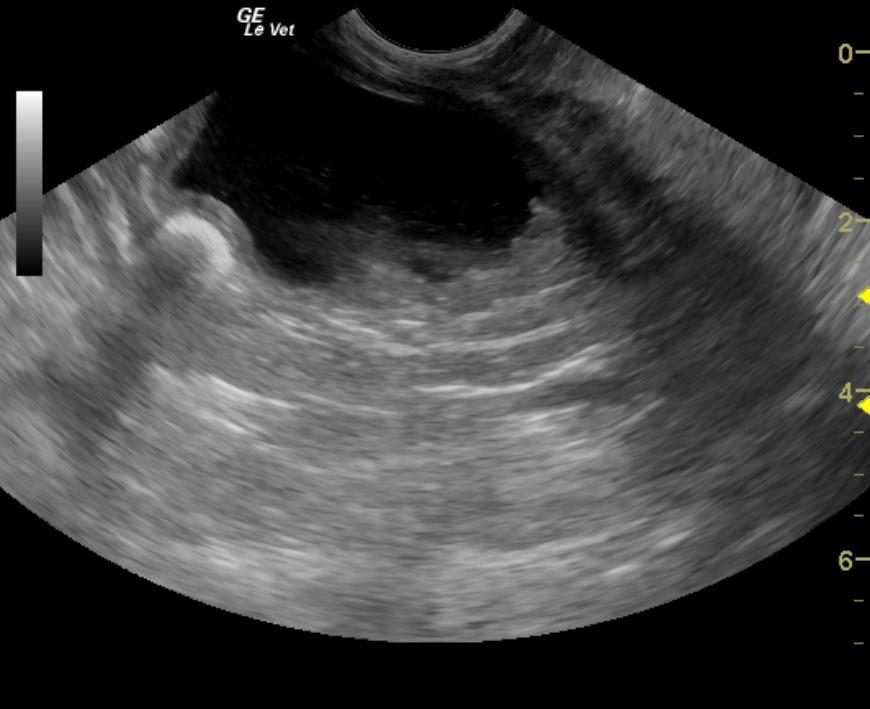
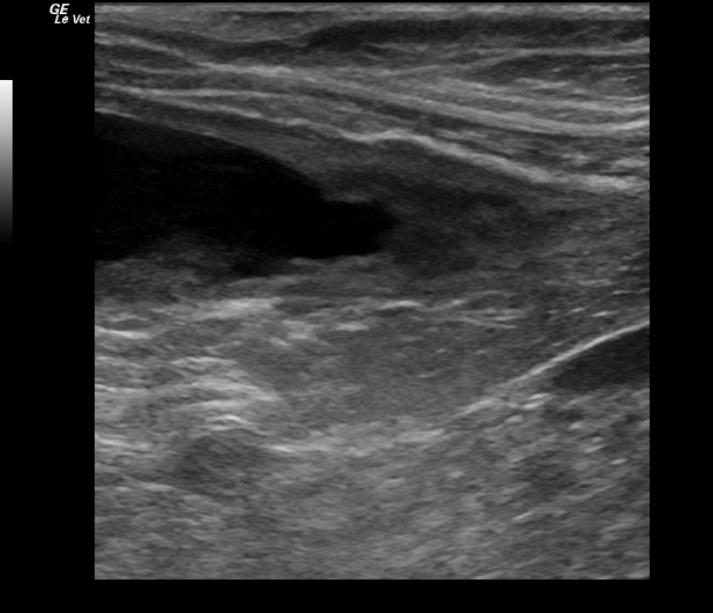
Sonographic Differential Diagnosis

Cystourethral junction polypoid changes. Suggestive for transitional cell carcinoma; polypoid urethritis is considered less likely.

Image Interpretation

The urinary bladder had normal, apical, ventral, and dorsal walls with normal ureters. However, the cystourethral junction contained a 1.5 x 0.6 cm, polypoid mass at the cystourethral junction, which may be causing persistent dysuria. Although the deep pelvic urethra appeared largely free of pathology, the proximal pelvic urethra appeared to be involved. This region should be accessible by cystoscopy and potential for ultrasound-guided laser ablation.

DX

Cystourethral junction polypoid changes, possible transitional cell carcinoma

Outcome

At last communication, the patient was doing well with no further urinary accidents.

Clinical Differential Diagnosis

Hormonal incontinence with secondary UTI. Bladder pathology – cystitis, neoplasia, urolith.

Sampling

Cystoscopy and potential ultrasound-guided laser ablation (UGELAB) was recommended. The owners decided not to pursue surgical options and the patient was treated with Pepcid, piroxicam, and eventual pulse antibiotics pending a follow-up urinalysis and urine culture.

Patient Information

Patient Name : Daisy S
Gender : Female, Spayed
Species : Canine
Type of Imaging : Ultrasound
Status : Complete
Liz Wuz Here : Yes
Code : 06_00024

Clinical Signs

  • Incontinence

Images

DaisyPolypodchangesTrigone

Clinical Signs

  • Incontinence

Urinalysi

  • Albumin Present
  • Amorphous Urate Present
  • Bacteria Present
  • Blood Present
  • Protein Present
  • Triple Phosphate Crystals Present
  • WBCs Present
Skip to content