CT- Cervical chronic degenerative intervertebral disc disease with step formation and spondylosis in a 16 year old MN Miniature Pinscher

Case Study

CT- Cervical chronic degenerative intervertebral disc disease with step formation and spondylosis in a 16 year old MN Miniature Pinscher

This 16 year old MN Miniature Pinscher presented with knuckling on the right front and crossing  hind limbs of unknown time duration; worsened as of trauma from falling off the bed.

Chem: Lipase 6000+

This 16 year old MN Miniature Pinscher presented with knuckling on the right front and crossing  hind limbs of unknown time duration; worsened as of trauma from falling off the bed.

Chem: Lipase 6000+

Image Interpretation

CT of the cranial cervical and cranial thoracic spine, plain- The patient is mildly obese.
There is a moderate generalized skeletal osteopenia.
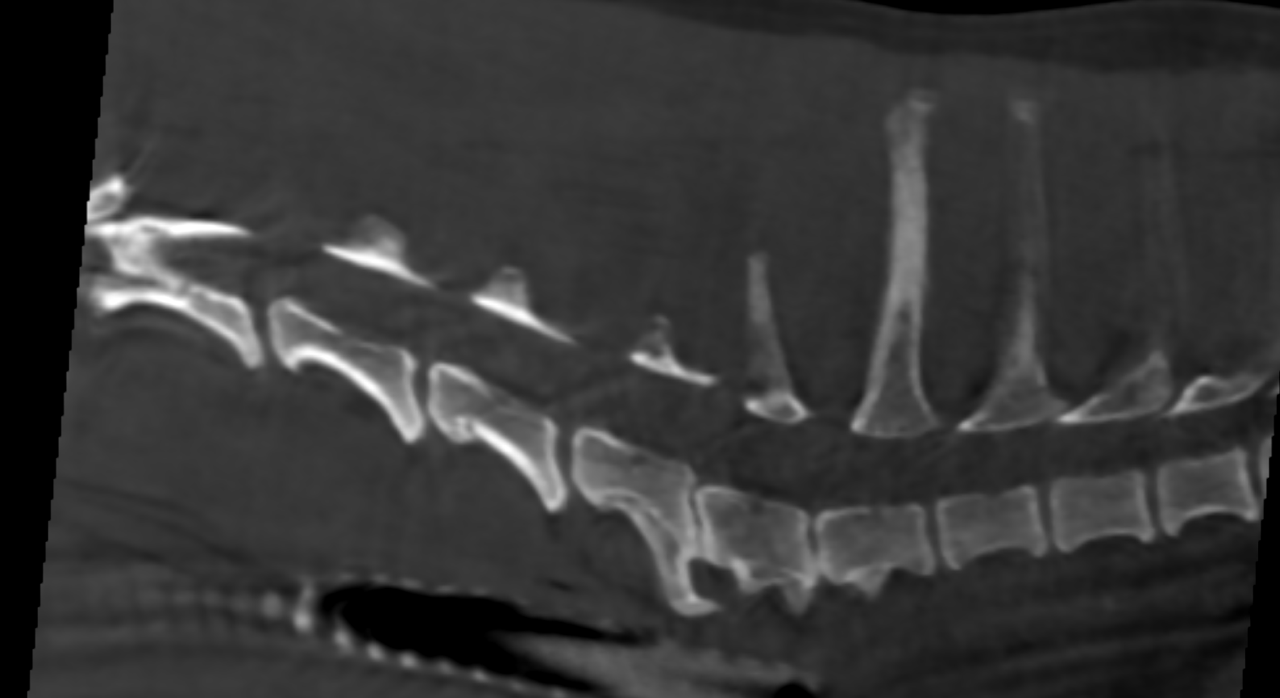
The intervertebral disc space of C6/C7 is collapsed and there is a severe partially
bridging spondylosis. There is a minor step formation of the vertebral canal floor at
C6/C7 with mild dorsal tipping of the endplate of C6.
The intervertebral disc space C7/T1 is severely narrowed with a moderate partially
bridging spondylosis.
The intervertebral disc spaces of C4/C5 and C5/6 reveal mild V-shaped narrowing.
The dorsal contouring of the ribs is mildly irregular, but well-defined.
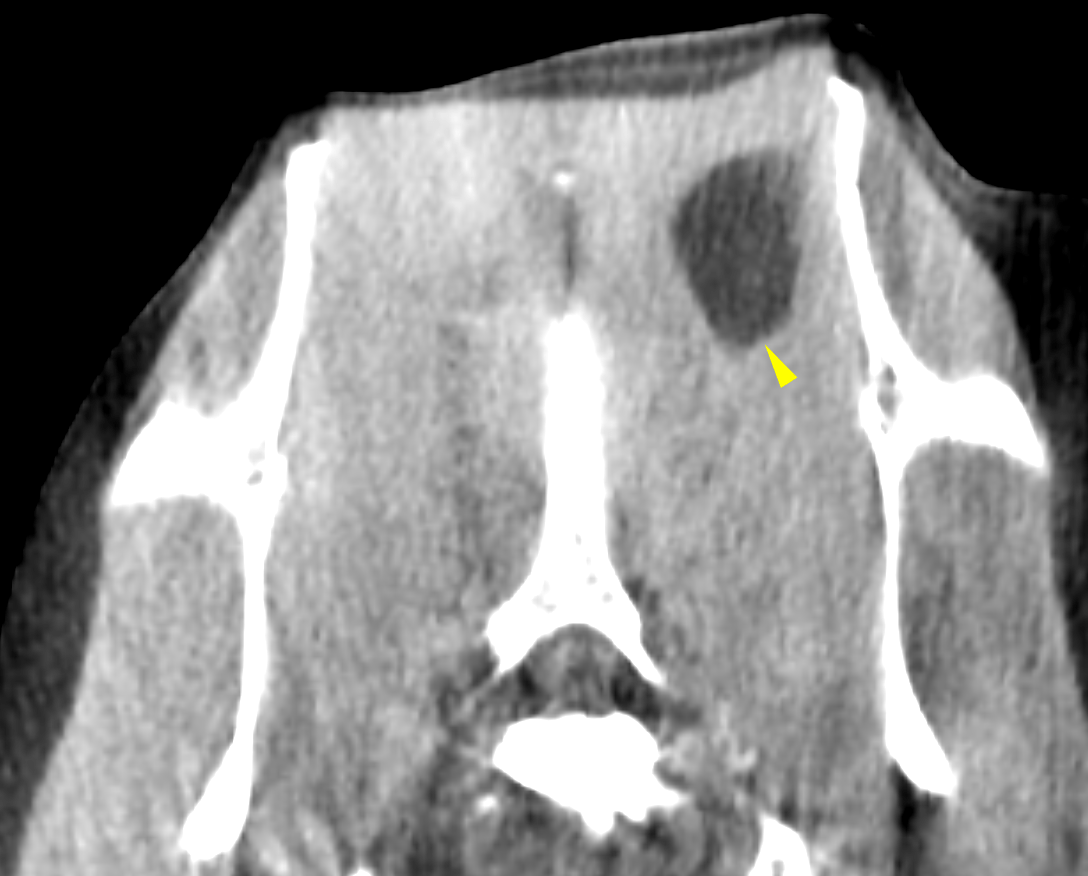
At the medioproximal aspect of the left scapula there is an ovoid well-delineated fat
attenuating (-100HU) mass lesion visible, which is 1.5 x 0.9 x 2.0 cm in size.
The volume of the left cranial lung lobe is severely reduced and shows a homogenous
soft tissue attenuation with airbronchograms.
DX

Multifocal cervical chronic degenerative intervertebral disc disease with minor step formation at C6/C7 and spondylosis - Left sided subscapulary lipoma - Compression atelectasis of the left cranial lung lobe due to positioning

Outcome

The findings are suggestive for multifocal disc hernia. The CT is negative for a recent
traumatic bone injury to the cervical and cranial thoracic spine (C2 through T4).
Full assessment of the impact on the spinal cord requires a myelographic or MRI
study. The CT findings should be correlated with the preceding MRI study.

Patient Information

Patient Name : Champ Booth/CVC
Gender : Male, Neutered
Species : Canine
Type of Imaging : Ultrasound
Status : Complete
Liz Wuz Here : Yes

Clinical Signs

  • Difficulty walking

Exam Finding

  • Neurologic signs

Images

bildschirmfoto_2016-01-26_um_11bildschirmfoto_2016-01-26_um_11

Blood Chemistry

  • Lipase, High

Clinical Signs

  • Difficulty walking
Skip to content