This cat presented with nasal congestion, otherwise nsf.
CBC/Chem: wnl
This cat presented with nasal congestion, otherwise nsf.
CBC/Chem: wnl
This cat presented with nasal congestion, otherwise nsf.
CBC/Chem: wnl
This cat presented with nasal congestion, otherwise nsf.
CBC/Chem: wnl
CT of the head, plain and post contrast – The computed tomography of the head reveals marked bilateral nasal turbinate
destruction. Moreover a moderate generalized swelling of the mucosal lining of the
nasal cavities is noted at the walls of the nasal cavities and the remaining nasal
turbinates. The bones of the nasal cavity appear to be mildly thinned and porous. Both
frontal sinuses are underdeveloped and filled with hypoattenuating homogeneous
material.
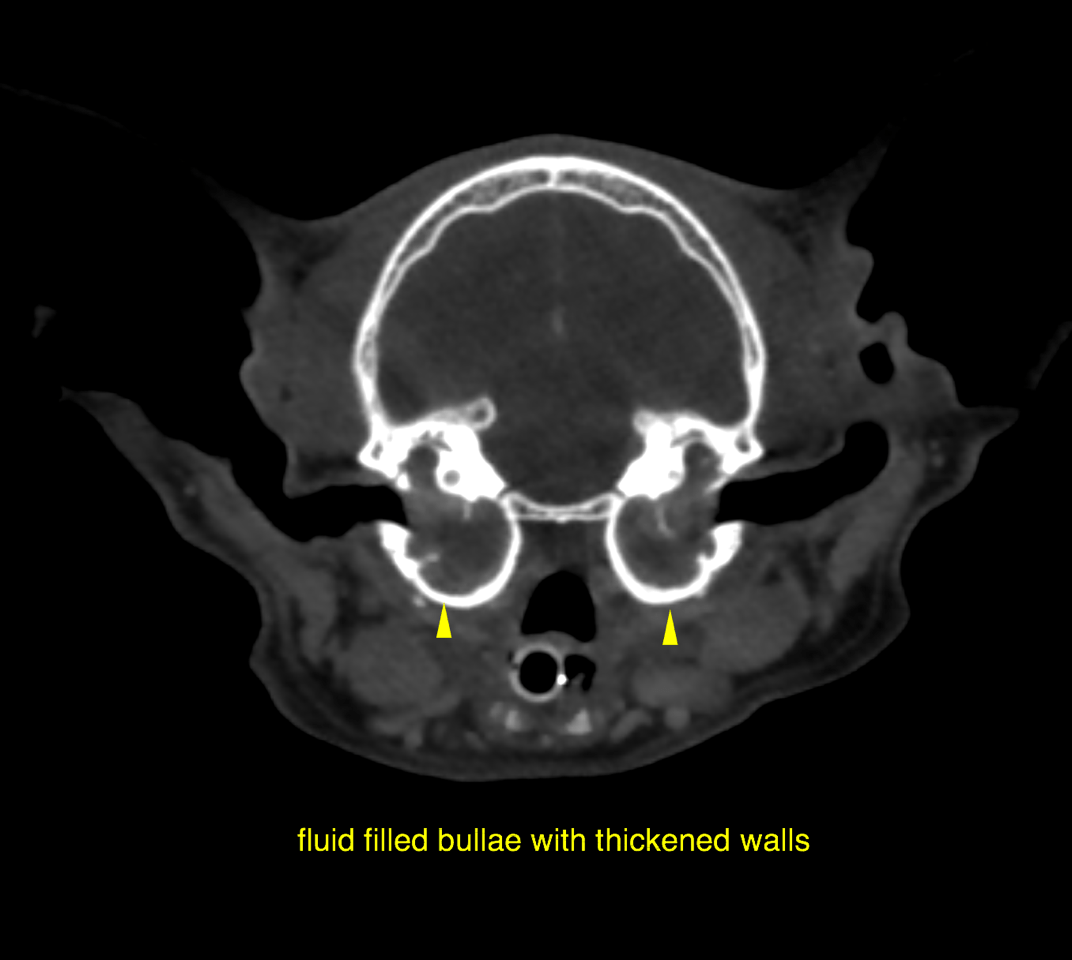
Both tympanic bullae are filled with homogeneously hypoattenuating and nonenhancing
material. The wall of both tympanic bullae reveals moderate generalized
thickening, yet the bony wall of the tympanic bullae is porous with multifocal
permeative small bony defects.
A moderate generalized pharyngeal soft tissue swelling is noted between the tympanic
bullae. A polyp is not recognized.
There is bilaterally symmetric moderate enlargement of the medial retropharyngeal
submandibular and parotid lymph nodes with preserved short and long axis ratio, but
heterogeneous contrast enhancement pattern.
Moreover there is bilateral moderate chronic otitis media with osteoproliferative and
osteolytic changes of the bony bulla walls.
The most likely underlying disease as fungal rhinitis sinusitis and otitis. In cats the most common microorganism causing fungal rhinitis is Cryptococcus neoformans.
The findings do not match viral rhinitis, also chronic bacterial rhinitis is unlikely
owing to the extensive turbinate destruction.
There is no evidence of nasal neoplasia or foreign body.
For further diagnostic workup samples for bacterial and fungal culture and
histopathology should be obtained guided by endoscopy. Even though there is no
indication of neoplasia histopathologic examination makes sense because frequently
fungal microorganisms are difficult to detect based on culture only.