Invasive adrenal mass in an 11 year old FS Labrador Retriever

Case Study

Invasive adrenal mass in an 11 year old FS Labrador Retriever

An 11-year-old FS Labrador Retriever dog was presented for the evaluation of polydipsia as well as a five pound weight gain over a five month period of time. The dog was obese and panting excessively on physical examination. Blood chemistry revealed hypoalbuminemia, hyperglobulinemia, hyperphosphatemia, increased ALT, increased AST, hypercholesterolemia and hyperamylasemia. Both lymphopenia and monocytosis were noted on the CBC. The thyroxine serum concentration (T4) was within normal limits.

An 11-year-old FS Labrador Retriever dog was presented for the evaluation of polydipsia as well as a five pound weight gain over a five month period of time. The dog was obese and panting excessively on physical examination. Blood chemistry revealed hypoalbuminemia, hyperglobulinemia, hyperphosphatemia, increased ALT, increased AST, hypercholesterolemia and hyperamylasemia. Both lymphopenia and monocytosis were noted on the CBC. The thyroxine serum concentration (T4) was within normal limits. The urinalysis showed an elevated pH, decreased specific gravity, cloudy appearance, proteinuria, and the presence of bacteria.
Sonographic Differential Diagnosis

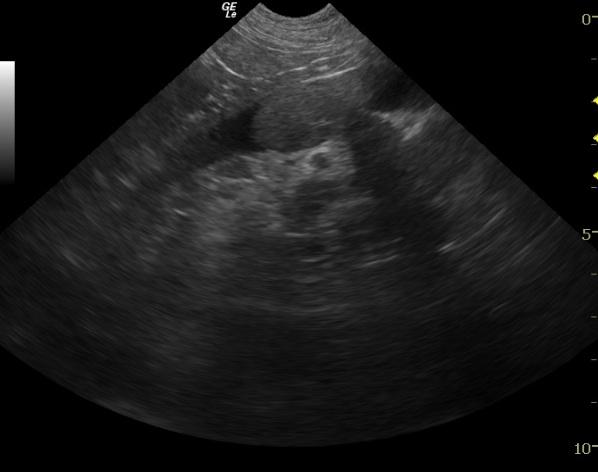
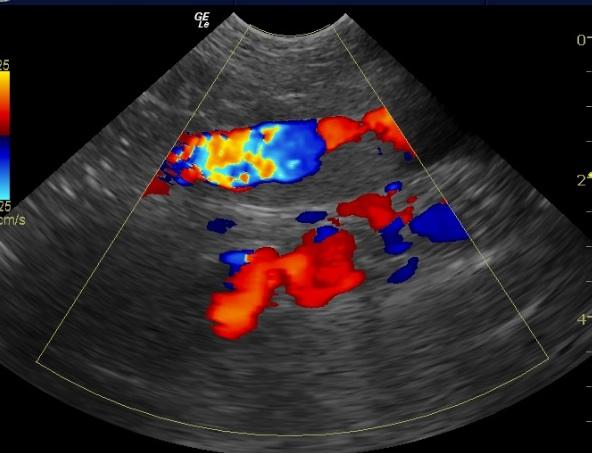
Invasive left adrenal mass. This is most likely adenocarcinoma or pheochromocytoma.

Image Interpretation

An invasive left adrenal mass is present. The images in this study show the left adrenal mass approached from the right side just caudal to the right adrenal gland. The remainder of the left adrenal in the mid field distal to the anechoic vena cava is largely normal. The normal right adrenal may be seen in the video coming into view before observing the invaded portion of the left adrenal mass.

DX

Invasive adrenal mass

Outcome

Follow-up CBC revealed a decreased hematocrit. Prothrombin time, PTT, and D-dimer were all within normal limits, although the fibrinogen was elevated. Several months later an ACTH stimulation test was performed and results were consistent with hyperadrenocorticism. A recheck ultrasound demonstrated the presence of an left adrenal mass with extension into the caudal vena cava, an enlarged right adrenal gland (consistent with hyperplasia from chronic non-adrenal disease or PDHAC), mild but non-specific liver changes, as well as renal changes consistent with a chronic nephropathy, most likely associated with a protein losing nephropathy. The patient died at home 9 months after the original diagnosis of invasive adrenal tumor.

Clinical Differential Diagnosis

Hyperadrenocorticism – pituitary-dependent or adrenal-dependent tumor (adenoma or adenocarcinoma), or an adrenal tumor causing the overproduction of sex hormones (atypical Cushing’s disease). Pheochromocytoma.

Sampling

US-guided FNA. Cytology results from the aspirate of the left adrenal gland were inconclusive due to a low cellularity and hemodiluted specimen. The owner declined repeating the FNA.

Patient Information

Patient Name : Seven F
Gender : Female, Spayed
Species : Canine
Type of Imaging : Ultrasound
Status : Complete
Liz Wuz Here : Yes
Code : 07_00020

Clinical Signs

  • Polydipsia
  • Weight gain

Exam Finding

  • Obesity
  • Panting

Images

CVCInvasionCVCwthcolorinvasion

Blood Chemistry

  • Albumin, Low
  • ALT (SGPT), High
  • Amylase, High
  • AST (SGOT), High
  • Cholesterol, High
  • Globulin, High
  • Phosphorus, High

CBC

  • Lymphocytes, Low
  • Monocytes, High

Clinical Signs

  • Polydipsia
  • Weight gain

Urinalysi

  • Appearance Turbid
  • Bacteria Present
  • pH High
  • Protein Present
  • Specific Gravity Low
Skip to content